I bring you a weekly bite-sized chunk of the science behind helicopter human factors and CRM in practice, simplifying the complex and distilling a helicopter related study into a summary of less than 500 words. This week: Helicopter flight with NVG – human factors aspects
Author Archives: Alex Pollitt
H2F BITESIZE #2
I bring you a weekly bite-sized chunk of the science behind helicopter human factors and CRM in practice, simplifying the complex and distilling a helicopter related study into a summary of less than 500 words. This week: Pilots gaze more outside while performing an auditory cognitive task.
H2F BITE-SIZE 1
I bring you a weekly bite-sized chunk of the science behind helicopter human factors in practice, simplifying the complex and distilling a helicopter related study into less than 500 words.
Creativity in the cockpit.

Can creative thinking help to mitigate the effects of operational unpredictability? Helicopter operations involve a high degree of unpredictability. A survey of helicopter crew has showed that a high proportion recognise the role that creativity plays in successfully managing uncertainty in flight operations.
Getting the right amount of stimulation from your simulation: What role does fidelity have in training to fly?
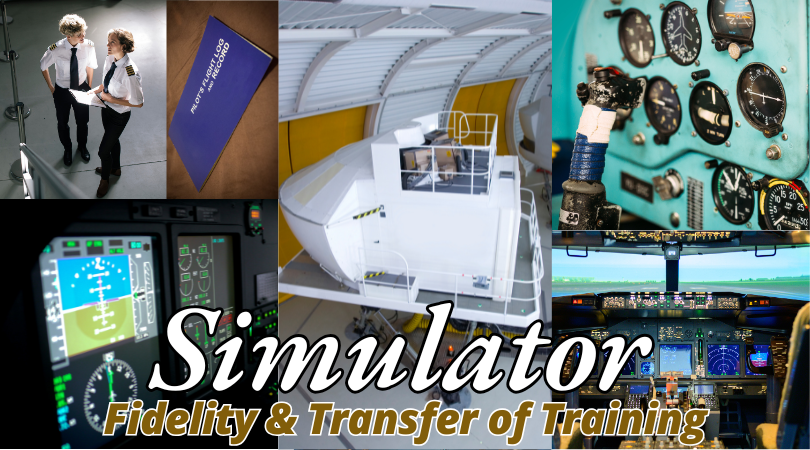
Full flight simulators are amazing tools for learning. Training devices have become more sophisticated, more true to the environment they recreate and, with this innovation, more expensive to use as well. But have these advances made them more effective as training tools in parallel, or is there a limit to the benefits of ever-increasing realism to the learning environment? This article aims to explain two of the key concepts in using simulated environments for training, fidelity and transfer of training, and invites you to consider the pros and cons of your own experiences of teaching and learning in the simulator.
How do you know when cognitive workload is affecting your performance?
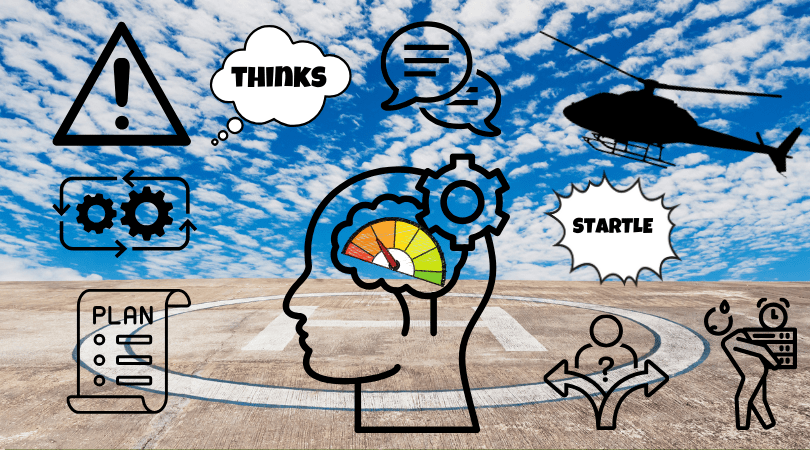
Cognitive workload is an important variable with which to understand pilot performance, particularly when under pressure, but measuring it is notoriously difficult. A recent study by Brazilian test pilots and academics investigated new methods of measuring it during helicopter emergencies. In a world in which we are adding advanced cockpit systems at an ever increasing pace a better understanding of how and when pilots are impacted by cognitive capacity will allow us to design better for management and mitigation of workload breakdowns in critical flight scenarios.
Military vs Civil: Does training background affect safety in helicopter pilots?

Which system produces the better pilot – military or civil? Does it matter? According to a recent study of helicopter pilots from the University of Aberdeen with the title “Does training background affect safety in helicopter pilots?” (Kaminska et al., 2023), maybe we are right to be asking these questions. The answers suggest that we need to pay more attention to how the military-civil divide impacts CRM behaviours amongst mixed crews. What do the cultural differences embedded in the different ways these pilots have been trained mean to competency, operational effectiveness, and – ultimately – safety?
A Bad Week
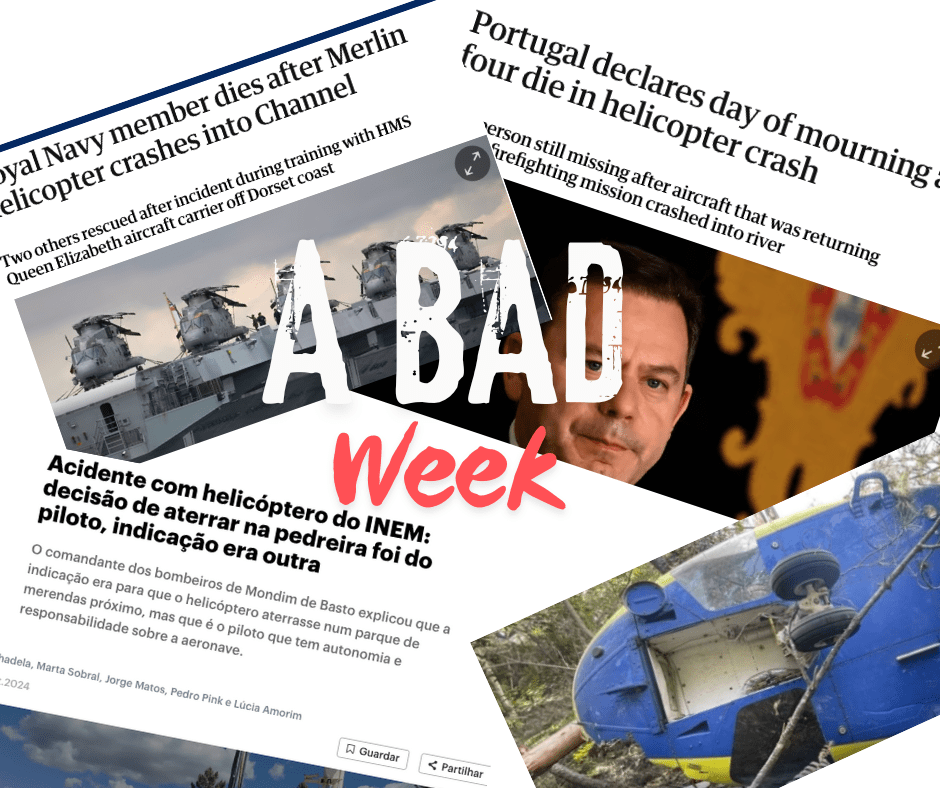
It’s been a been a tough week for helicopter aviation. In Western Europe, three accidents in six days. Six lives lost. More seriously injured. In the rest of the world, another five accidents and over twenty lives. In six days. So many accidents in such a short period of time delivers a strong reminder to us about the kind of tasks that we as a society ask of our helicopters and their crews: They are often difficult, and sometimes dangerous, even for the very best of them.
On helicopters, elephants, and training.

This is the elephant in the room that has been stubbornly refusing to move: very little has changed in how we train helicopter pilots for four decades or more. In the meantime much else has changed, but collectively we are unwilling – or unable – to make significant changes to what the training and checking system prescribes. Why is this? And what should we do about it?
Sting in the tail: keeping the back end in the front of your mind.

It’s hard to believe that the AW169 tail rotor failure over Leicester City Football Club happened over five years ago. Following the accident in 2018 I was asked by my Head of Training at the time to focus some training for crews on tail rotor malfunctions which led me to CAA Paper 2003/1 Helicopter TailContinueContinue reading “Sting in the tail: keeping the back end in the front of your mind.”
Navigating cross-cultural turbulence: Why the multi-national complexion of aviation demands we should all add culture to our competencies.

Just mentioning the word culture seems often to be met with a glazing over of eyes. I learned that discussing ‘cultural capability’ in the military was unfashionable, uncool, and frankly unmilitary. I have a sense that the same is true in the world of aviation, which is ironic given the uniquely international nature of the industry…
Ready for anything? Non-technical skills in helicopter operations
Prologue A seriously injured sailor lay crying in agony after falling down a deck hatch. Suffering from severe concussion, and multiple fractures, he lay awkwardly, deep inside his boat, wedged between engine and fishing machinery. It was the job of the helicopter rescue swimmer to work out how to remove him to a place ofContinueContinue reading “Ready for anything? Non-technical skills in helicopter operations”
What makes you good at what you do?
Lloyd Horgan Photography “Are you good at your job?” “What makes you good at what you do?” Presenting a briefing with the title “Are we good at what we do?,” I recently asked these questions to a group of around twenty-five professional aircrew. Of course almost all of us think we are good at whatContinueContinue reading “What makes you good at what you do?”
Hindsight: blessing or curse?
Have you ever read an accident report, had an incident related to you, or sat through a CRM case study that made you say out loud something like:
“What were they thinking?” “Why on earth did they decide to do that?” “How could they not have known?” “They must have seen that coming, surely?”
If you have – and we all have – then you have fallen victim to probably the most powerful and omnipresent psychological bias out there: the hindsight bias.
Hovering over the hill: are helicopter crews getting older?
Earlier this year I collected data from a survey of the global helicopter community as part of a study into non-technical skills in helicopter operations. The phenomenal response to this survey from over five hundred participants produced a rich dataset which includes a contemporary demographic snapshot of the helicopter industry worldwide. After just a cursoryContinueContinue reading “Hovering over the hill: are helicopter crews getting older?”
A very normal accident
It was early evening on the 24th September 2022 when an offshore AW139 helicopter inbound to Houma-Terrebonne Airport in Louisiana, USA, declared a mayday. A lot had already happened in the cockpit by the time the co-pilot hit the press to transmit…
We take a look at Normal Accident theory in the light of a recent accident: Technology is both a risk control and a hazard itself. The act of adding technology is at best risk neutral. Continually adding more technology in the belief that we are adding more layers of defence in a system is flawed because we are in fact adding more combinations of possible failure modes. In other words, there is a direct trade- off between increasing safety by adding in more controls, and decreasing safety by adding complexity.
Helicopter human factors in focus
“For no other vehicle is the need for human factors research more critical, or more difficult.” Sandra G. Hart.
That’s a bold assertion that I had never heard anyone make before and consequently had never given much consideration to whether or not it might be the case. So let’s unpack that proposition a little by looking at the arguments that the author offers to back it up…
The safety dividend of aviation’s professional culture?
How much does an aviator’s own cultural identification with safety have a role in contributing to safety outcomes? Certain professions have strong and distinctive professional cultures. Aviation is one of these. Does a belief in a deep-rooted safety culture underpin how aviators identify as professionals?
Does complacency really cause errors?

Attributing complacency as a cause of human error is as easy as it is lazy. Why?
Towards E-VFR flight: The dawn of mixed reality in the rotary wing cockpit?
How progress in head-mounted display technology could revolutionise critical helicopter missions. Image from Viertler, F. X. (2017). Visual Augmentation for Rotorcraft Pilots in Degraded Visual Environment Envision a world in which emergency aircraft and their crews can launch in response to medical and other critical missions in almost any flight conditions imaginable. E-VFR (Electronic-VFR) speaksContinueContinue reading “Towards E-VFR flight: The dawn of mixed reality in the rotary wing cockpit? “
The need for speed? How slowness has a value all of its own.

Human exploits in aviation have always been closely linked to our fascination for speed. We admire speed in its many guises and it remains a marker of achievement in almost any field you care to think of. In aviation, just as in many other walks of life, we often assume the faster the better. We associate speed with competence. But what if we could disassociate the idea of slowness with incompetence? What if instructors were made to teach the opposite? What if we came to associate a slow response with higher skill levels and greater professionalism?
Developing resilience to startle and surprise in helicopter operations
Also published in AirMed&Rescue April 2022 edition. https://www.airmedandrescue.com/latest/long-read/developing-resilience-helicopter-operations
What should startle and surprise training mean in an applied sense and how should we be approaching it? Do the differences between airline transport flight profiles and helicopter operations mean that we should be looking critically at how to approach the startle and surprise from a rotary wing perspective? Is it as significant a hazard in the low level, high workload, high obstacle environment in which helicopter crews spend much of their time?
The automation explosion: examining the human factor fallout
Also published in AirMed&Rescue, Nov 2021 edition.
Automation reduces workload, frees attentional resources to focus on other tasks, and is capable of flying the aircraft more accurately than any of us. It is simultaneously a terrible master that exposes many human limitations and appeals to many human weaknesses. As we have bid to reduce crew workload across many different tasks and increase situational awareness with tools including GPS navigation on moving maps, synthetic terrain displays, and ground proximity warning systems, we have also opened a Pandora’s Box of human factors to bring us back down to the ground with a bump. Sometimes literally.
Distributed Situation Awareness
Pretty much everyone in aviation is familiar with the concept of situation awareness. But as research interest in SA grew, the concept expanded from the individual level to how SA might apply in the context of larger and more complex systems. What does distributed SA actually mean? The idea is that SA is held by both human and non-human agents. Myriad technological artefacts within a system also hold some form of SA. Now if, like me, you initially struggle with the idea that an artefact (such as a radio, or altimeter) can have ‘awareness’, then bear with me…
Processing information in flight: Understanding the limits of cognitive capacity in the cockpit.
Hands up if you have ever experienced a mental meltdown, ‘cognitive freeze’, or intense tunnel vision in flight or in training? Most of us will recognise these phenomena happening to us at some point or other. They are intimately related to levels of workload, stress, or perhaps the surprise and startle effect. In CRM trainingContinueContinue reading “Processing information in flight: Understanding the limits of cognitive capacity in the cockpit.”
ARE YOU A SPECIALIST AVIATOR? WHY DEVELOPING RANGE IS PART OF YOUR JOB.
Photo: Lloyd Horgan Most of us will recognise amongst our colleagues that figure who has an unmatched knowledge of their aircraft and operational procedures but isn’t a natural team player, doesn’t share thought processes much, and just perhaps doesn’t quite integrate with the rest of his/her colleagues as comfortably as others. We admire technical knowledgeContinueContinue reading “ARE YOU A SPECIALIST AVIATOR? WHY DEVELOPING RANGE IS PART OF YOUR JOB.”
Helicopter Hoisting and the Human in the system:
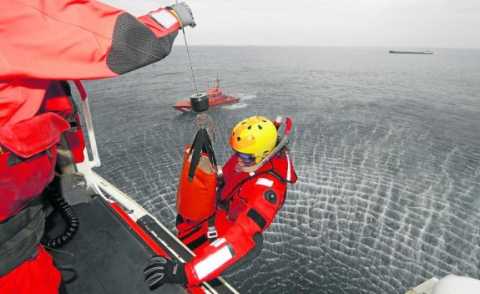
Applying the 3Hs to decision-making during helicopter hoist operations. On the 29 April 2020 at Biscarosse near Bordeaux in France, two crew members of a French Air Force H225 fell to their deaths when a hoist cable parted during a winch training exercise. (Summary report in English from Aerossurance.) The tragic outcome coupled with theContinueContinue reading “Helicopter Hoisting and the Human in the system:”
On Lookout and helicopters
The importance of an effective lookout. We’ve heard it from day one in aviation, a constant through our flying training days and beyond. The dangers of mid-air collision, obstacles, and controlled flight into terrain (CFIT) will always be there. These are not static threats however, but are always evolving. Take the proliferation of drones asContinueContinue reading “On Lookout and helicopters”
Developing Competency in Problem-Solving and Decision Making: The importance of Process vs Outcome.
Separating the quality of a decision from the quality of the processes which lead to a decision being made sounds like it should be straight-forward, but it isn’t. This is especially true if we judge a decision to be a bad one, or a wrong one, when our negative perception of the choice can easily overwhelm what could have been a perfectly acceptable, collaborative, and well-communicated thought process.
The distinction between the quality of the decision-making process and the decision itself is an important one to make in the context of training for competency because although we won’t always make the right, or the best, decisions in any given situation, the ability to develop and improve our decision-making processes, is what competency-based training is all about.
Competency based training. By trying to solve one training problem are we creating another?
At the beginning of this month I tuned in to the Royal Aeronautical Society’s webinar titled, Flight Crew Competence; Assessing what and how? The webinar aimed to address the concept of Evidence Based Training and Competency Based Training (EBT/CBT) and consider the impact it has had on the experience of instructors, examiners and trainees. TheContinueContinue reading “Competency based training. By trying to solve one training problem are we creating another?”
Small Talk, Big distraction: Taking a look at the sterile cockpit concept through the lens of helicopter operations
The concept of the ‘Sterile Cockpit’ as a defence against distraction is a well known one, even well below the cruising levels of the world’s airline operations. The chances are most helicopter pilots will be familiar with it as a company Standard Operating Procedure. Not so many will know that it is in fact aContinueContinue reading “Small Talk, Big distraction: Taking a look at the sterile cockpit concept through the lens of helicopter operations”
The checklist in the rotary wing cockpit: Understanding what, why, and how.
Do helicopter crews have as good an understanding of the proper use of checklists and checklist philosophy as their airline pilot brethren? Like everyone else, I have worked with checklists since I first set foot in the world of aviation. They are omni-present. But my in own experience – as far as I can recollectContinueContinue reading “The checklist in the rotary wing cockpit: Understanding what, why, and how.”
AERONAUTICAL DECISION-MAKING AND LOSS AVERSION:
What Nobel Prize Winner Daniel Kahneman can teach us about why taking the hardest decisions of them all is so hard. In his book Thinking Fast and Slow Nobel Prize winning economist and thinker Daniel Kahneman introduces us to many fascinating insights into the human decision-making process. Loss Aversion is one of these. He beginsContinueContinue reading “AERONAUTICAL DECISION-MAKING AND LOSS AVERSION:”
Crew Resource Management Training from Classroom to Cockpit. Are we missing a link?
When preparing for a trip to the simulator most of us start by reaching for the emergency and abnormal checklist to refresh ourselves on the inevitable bevvy of aircraft malfunctions that we know will be coming our way in due course. Who hasn’t come across that sim instructor who feels it would be a derelictionContinueContinue reading “Crew Resource Management Training from Classroom to Cockpit. Are we missing a link?”
Don’t neglect your CRM: The value of telling stories
Last week was a CRM week. I was immersed in a Crew Resource Management course for aspiring facilitators with three full days dedicated to talking, listening, and learning about flying, human factors, and facilitation. Learning from the experiences of others is a lot of what human factors training is about. You don’t do that withoutContinueContinue reading “Don’t neglect your CRM: The value of telling stories”
Flying SAR in the sunshine: What’s not to like?!
From the Atlantic to the Mediterranean: The Weather. Learning to adjust. And just learning. On moving to Valencia last year to try my hand at flying a Search and Rescue helicopter in Spain, the predominantly anti-cyclonic picture of Spain’s Mediterranean-facing east coast presented an entirely new meteorological situation to me. “SAR in the sunshine, what’sContinueContinue reading “Flying SAR in the sunshine: What’s not to like?!”
Is Human Factors in aviation at a crossroads?
Now seems like a good time to look beyond the dark prism of the current COVID-induced crisis in aviation to consider a future beyond the mire. The Chartered Institute of Ergonomics and Human Factors (CIEHF) recently published a White Paper called “The Human Dimension in Tomorrow’s Aviation System”. It’s made up of a series ofContinueContinue reading “Is Human Factors in aviation at a crossroads?”
Can you learn to deal with the unexpected & unpredictable?
Cognitive Readiness in Search and Rescue operations: What is it? Do you have it? How do you get it? There’s a problem with training to learn to deal with the unexpected: we simply don’t know in advance what the objectives of any training or instruction should be. If you haven’t come across it already, CognitiveContinueContinue reading “Can you learn to deal with the unexpected & unpredictable?”
Can a fatal accident provide proof that CRM training does save lives?
On July the 4th last year an AW139 departing from Big Grand Cay in the Bahamas at night hit the water shortly after take off killing all on board. The US National Transport Safety Board (NTSB) has just released the transcript from the cockpit voice recorder carried on board. Perhaps the most shocking part ofContinueContinue reading “Can a fatal accident provide proof that CRM training does save lives?”
Full Crew Flight Monitoring: mitigating the unique hazards in HEMS operations.
EASA’s Annual Safety Recommendations Review 2019 has identified HEMS as one of its key safety topics noting that, “EASA has received several Safety Recommendations over the last years related to this topic.” before going on to comment that, “There are several unique hazards faced by Helicopter Emergency Medical Services (HEMS) operations. The time pressure, planning challengesContinueContinue reading “Full Crew Flight Monitoring: mitigating the unique hazards in HEMS operations.”
Decision Making in a complex environment: The role of experience, intuition, and the contribution of team behaviours.
What is a complex environment? Put simply, a complex environment is a system or situation that has too many elements and relationships to understand in simple analytical or logical ways. It is a landscape with multiple and diverse connections, and dynamic and interdependent relationships, events, and processes. While there may be trends and patterns, theyContinueContinue reading “Decision Making in a complex environment: The role of experience, intuition, and the contribution of team behaviours.”
Crew Resource Management for Search and Rescue Operations.
It’s a personal opinion, but I think that one of the most enduring fallacies of Search and Rescue, (and one that SAR practitioners worldwide are unlikely to be working hard to shake off!), is that it is somehow an elite branch of the helicopter world that requires a higher level of skill or ability thanContinueContinue reading “Crew Resource Management for Search and Rescue Operations.”
Flattening the gradient
What former US Navy Captain and leadership guru David Marquet can teach us about managing power gradient. The premise of David Marquet’s book Leadership is Language, (For more on Marquet click to his website) is that the deliberate and self aware choice of language in how we communicate within teams can transform the way we communicateContinueContinue reading “Flattening the gradient”
The Chimp, the Virus, and the Helicopter:
Coping with confinement and COVID-19 induced stress. What is the link between a chimp and a helicopter?… apart from the fact that every instructor you ever had told you that any monkey can be taught to fly one! In his best-selling book The Chimp Paradox, Professor Steve Peters (click for further information) describes a sevenContinueContinue reading “The Chimp, the Virus, and the Helicopter:”
Crew Resource Management: Is it time to rethink our approach?
Let’s not beat around the bush, Crew Resource Management has an image problem. For many, CRM training means little more than a day in the classroom which generally inspires at best a resigned ambivalence. CRM has an image problem… Perhaps, there has been a failure to attempt to define CRM for what it really is.ContinueContinue reading “Crew Resource Management: Is it time to rethink our approach?”
“Engine failure! Cut cut!” Power loss during winching operations: the pre-eminent risk in your assessment?
“Clear door, ready to winch.” “Power assessment/hover scenario: Ditching/Committed/Flyaway/Safe Single Engine.” For most of us who fly multi-engine helicopter types, single engine performance and the choice of flight profiles deriving from this was introduced as a predominant consideration from the beginning of our flying training, and has remained there ever since. Our pre-flight calculations, ourContinueContinue reading ““Engine failure! Cut cut!” Power loss during winching operations: the pre-eminent risk in your assessment?”
The Structured Debrief: The Big 7
The Structured DebriefDuring my time in the military a debrief often began with the question, “Any flight safety points?” A closed question. A question that invites a no. It was meant to show the primacy of flight safety in what we were doing. What it actually did was immediately put people on the spot ifContinueContinue reading “The Structured Debrief: The Big 7”
Debrief to learn: El debriefing para aprender
El empleo del ‘debriefing’ como herramienta de entrenamiento para los profesionales aeronáuticos es la manera más eficaz para aprender, hablar de la toma de decisiones, adquirir/revisar habilidades técnicas y mejorar el trabajo en equipo. Effective debriefing as a training tool for aviation professionals is the most effective way to learn, to talk about decision-making, toContinueContinue reading “Debrief to learn: El debriefing para aprender”
What does the language barrier mean to the multi-national cockpit?
The challenges of piloting an aircraft can often load us up enough without overlaying the cognitive effort involved in transmitting and receiving information in a language other than our own. But plenty of pilots out there do just that every day. In aviation, those of us lucky enough to have English as our motherContinueContinue reading “What does the language barrier mean to the multi-national cockpit?”
What delivering two years of CRM training has taught me.
Something over two years ago I decided I would throw my hand in at applying to be a CRM Trainer and Human Factors Facilitator. CRM had never really been my thing. My experience of Human Factors/CRM training up to that point was that ‘facilitators’ tend to be either evangelical to the extent that their fervourContinueContinue reading “What delivering two years of CRM training has taught me.”
 competentaviators.com