
I bring you a weekly bite-sized chunk of the science behind helicopter human factors and CRM in practice, simplifying the complex and distilling a helicopter related study into a summary of less than 500 words.
TITLE:
The Virtual Landing Pad: Facilitating rotary-wing landing operations in Degraded Visual Environments (DVE).
WHAT?
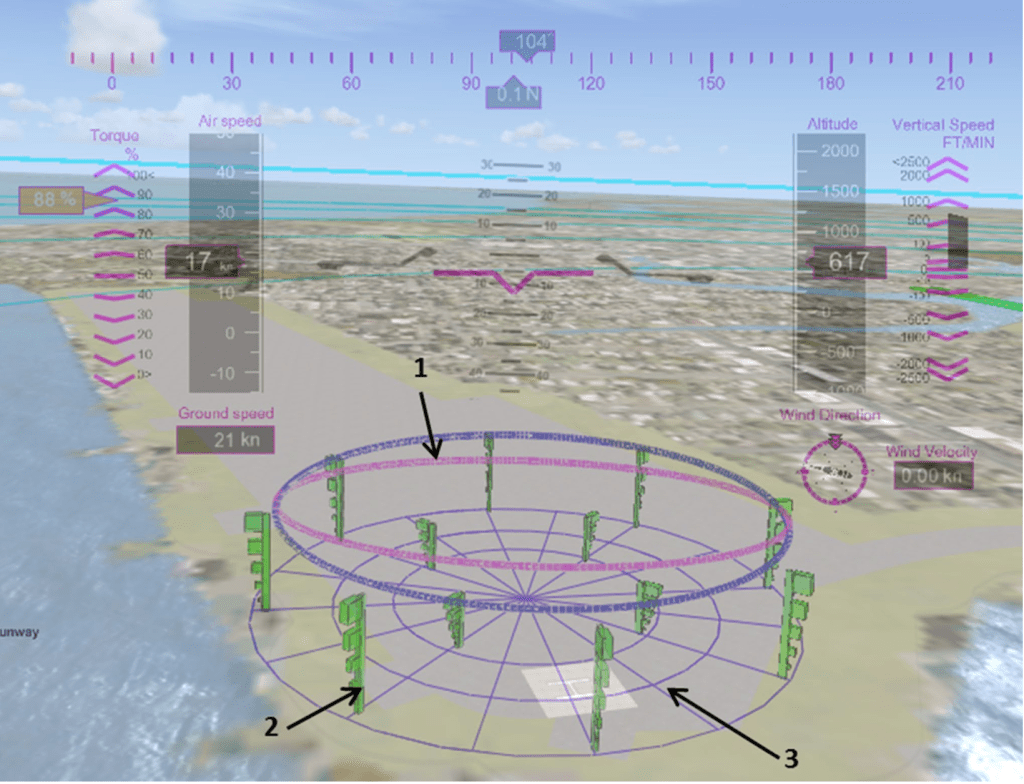
Study investigating whether a head-up display (HUD) could assist helicopter pilots during landings in DVE. The HUD incorporated 2D flight data and 3D conformal symbology (synthetically overlaid terrain and visual cues) to enhance workload management and situation awareness during hover and landing.
WHERE?
Where?
University of Southampton, UK, using fixed-base flight simulator.
WHEN?
When?
Published February 2018 in the journal Cognition, Technology & Work.
WHY?
Helicopters are vulnerable to accidents in poor visibility because pilots rely on external visual cues for spatial orientation and control. HUDs have been studied and used operationally in fixed wing flying but are less common in rotary wing operations. The study aimed to determine whether a HUD could reduce cognitive workload and aid situational awareness (SA) when visual cues are degraded, potentially improving safety and operational capability.
HOW?
13 qualified rotary-wing pilots flew simulated approaches and landings under four conditions.
- Clear visibility without HUD
- Clear visibility with HUD
- Fog (DVE) without HUD
- Fog (DVE) with HUD
The simulation used a Eurocopter flight model. Flight performance parameters were measured, with pilots providing subjective workload and SA data via questionnaires.
FINDINGS:
The HUD significantly reduced pilot workload in degraded visual environments.
Using the HUD in clear conditions slightly increased mental workload but did not harm performance, suggesting it could be used with no negative impacts in all flight conditions.
In degraded conditions no significant improvement was found in SA with the HUD, but pilots maintained levels comparable to those in clear conditions without HUD.
Overall, the HUD helped pilot performance in DVE, reducing workload while keeping SA stable.
Previous studies in fixed wing aircraft have demonstrated the value of displaying task-relevant information on HUD. These findings suggest rotary wing specific data supports evidence from fixed wing on the benefits of these kind of displays.
SO WHAT?
Helicopter flight in DVE remains a significant safety challenge in helicopter operations, reducing SA and increasing workload. By allowing pilots to fly “eyes-out” while accessing critical flight information, workload peaks and operational risk are mitigated during low-visibility landings. This study suggests further HUD refinement is needed (particularly display clarity and intuitive helicopter-focused symbology) to balance cognitive demands and maximise benefits.
REFERENCE:
Stanton, N. A., Plant, K. L., Roberts, A. P., Allison, C. K., & Harvey, C. (2018). The virtual landing pad: Facilitating rotary-wing landing operations in degraded visual environments. Cognition, Technology & Work, 20(2), 219–232. https://doi.org/10.1007/s10111-018-0467-1
 competentaviators.com