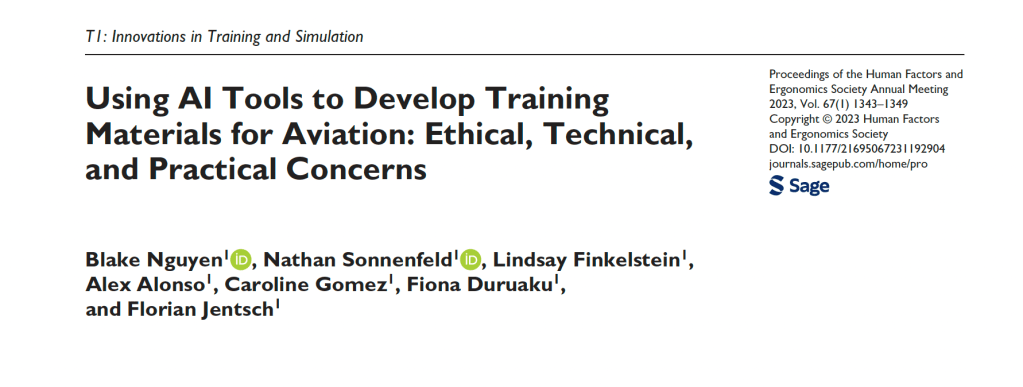
Artificial intelligence is rapidly moving from the realm of tech-headline into everyday professional practice. In aviation training, an industry built on procedural precision, standardisation, and regulatory oversight, the arrival of AI tools represent both an opportunity and a challenge. A recent peer reviewed study by Nguyen et al., (2023) titled Using AI tools to develop training materials for aviation: ethical, technical, and practical concerns, explores how emerging AI capabilities could be applied across the flight crew training design pipeline, from scenario creation and instructional design to assessment and training evaluation.
The potential significance of the AI revolution should not be underestimated. Aviation training has historically evolved through improvements in simulation technology, data analysis, and instructional design. AI is likely to represent the next major shift. Tools capable of generating text, images, audio, and interactive content, combined with machine learning systems capable of quickly and efficiently analysing training performance, have the potential to dramatically change how training materials are created, delivered, and evaluated.
Yet, as with every technological leap forward in aviation, enthusiasm for what it has to offer needs to be balanced with careful consideration. AI can undoubtedly accelerate training development and personalise learning experiences, but, as the authors to this paper are at pains to highlight, it also introduces questions about reliability, ethics, data governance, and the evolving role of instructors. This article explores the implications of these developments for aviation training, beginning with the potential contributions of AI to training design and delivery, before examining in more detail the practical challenges and risks that training organisations must navigate as these technologies become more widely adopted.
The potential contributions of AI to aviation training
Supporting the entire training design pipeline
One of the most striking possibilities raised by AI is its ability to support the entire training design pipeline. Traditionally, developing new training requires a series of labour-intensive steps: analysing operational needs, defining training objectives, designing learning activities, creating training materials, delivering the training, and evaluating its effectiveness. AI tools now have the potential to assist at each of these stages of the training cycle. Machine learning systems can analyse operational data to identify emerging safety trends, while generative AI tools can help draft training scenarios, create briefing materials, and support assessment processes.
Consider a fleet experiencing a growing number of unstable approaches at several airports. In the past, identifying the trend, designing a training intervention, and building the necessary materials might have taken weeks. AI systems could assist by rapidly analysing operational reports, generating draft scenarios based on the identified risk factors, and producing the supporting instructional materials. The training department still exercises professional judgement in shaping the final product, but the time between identifying a safety concern and delivering targeted training is dramatically reduced.
Accelerating training development
Another significant contribution lies in the efficiency of training development. Generative AI tools can produce draft text, diagrams, instructor guides, audio narration, and visual content in a fraction of the time required by traditional methods. For large operators with extensive training departments this may ease workload, but for the smaller ones it could be transformative. Training designers without access to large production teams can now produce professional-quality materials with relatively modest resources.
Instead of building every slide, script, and diagram from scratch, a designer might use AI tools to generate the first draft of the lesson plan, produce graphical illustrations of aircraft systems, and even generate audio for scenario briefings. The instructor’s expertise remains central to this process by ensuring accuracy, realism, and operational relevance, but the heavy lifting of content production is far more manageable.
Enabling adaptive and personalised training
AI also opens the door to a more adaptive and personalised training experience. Traditionally, aviation training follows a standardised model: every pilot completes the same syllabus regardless of individual strengths or weaknesses. AI-driven training systems could change this approach by analysing performance data and adjusting training content to individual competencies.
Take the example of a pilot who consistently struggles with maintaining the correct sight-picture during visual approaches. An adaptive system could quickly recognise this pattern, identify the deficiencies in visual scanning, and introduce additional exercises designed to strengthen that specific skill. Conversely, the pilot who demonstrates strong proficiency could be presented with more complex decision-making scenarios instead. Over time, training will evolve from a one-size-fits-all process into something closer to tailored instruction.
Implications, risks, and traps
The reliability challenge
Despite the promise of these developments, the introduction of AI into aviation training also raises some concerns. Perhaps the most immediate of these is the reliability of AI-generated information. Generative AI systems can produce polished and convincing outputs, but their veracity is still infamously fallible. In some cases they may produce information that might appear authoritative but is technically incorrect or operationally misleading. For aviation training, where procedural accuracy is essential, this creates an obvious risk and a challenge to transparent quality control. The errors might be small, but in aviation even small deviations matter, and the responsibility for validating that content remains firmly with the instructors and subject matter experts.
The domain knowledge gap
Another challenge lies in the nature of the data used to train AI systems. Most widely available AI tools are trained on vast collections of general internet data rather than aviation-specific information. As a result, their outputs may lack the depth and precision required for operational training contexts. The nuances of airline procedures, aircraft systems, and real-world operational constraints are not always well represented in these generic datasets.
Ask a general AI system to explain crew resource management and it will likely provide a reasonable summary. Ask it to generate a detailed line-oriented training scenario involving weather deviations, fuel considerations, and complex ATC constraints, and the result may feel oddly generic and unworkably detached from the realities of the operation in question. The future of AI in aviation training will probably lie in the development of specialised models trained on validated aviation data.
Ethical and legal considerations
The ethical and legal implications of AI in training also need careful attention. Modern training systems already collect large amounts of data about trainee performance. With the integration of AI-driven analytics, these datasets could expand to include biometric information, eye tracking data, or indicators of cognitive workload. While such information would undoubtedly improve training insights, it also raises legitimate questions about privacy, consent, and data governance. Pilots will understandably want to know how this data is stored, who has access to it, and how it might be used in performance evaluation, so trust between pilots and training organisations will probably become a critical factor in the acceptance of these technologies.
Changing the skillset of training designers
AI could also slowly reshape the skillset required of aviation training professionals. As automation becomes more capable of generating training content, the role of the training designer may shift away from producing materials toward curating and validating them. In the same way that automation in the cockpit has changed the pilot’s role from manual operator to systems manager, AI could change the training designer’s role from content creator to learning architect. Future instructors will need to become skilled not only in instructional design, but also in managing AI tools, evaluating the accuracy of the material they generate, and interpreting complex training data analytics.
Augmentation, not replacement
Finally, it is worth emphasising this point that AI should augment human instruction rather than replace it. Aviation training is not simply about transferring experience, it is about developing judgement, decision-making, and professional mindset. These qualities are more often than not shaped through mentorship, learning from experience, and the subtle insights shared by or inferred from instructors who have faced similar situations in real operations. Most pilots can recall a moment during training when an instructor’s story or personal experience fundamentally changed how they approached a situation in the cockpit, and these are the moments of learning which can’t be replicated through algorithms. AI may help construct the training environment, but the human instructor will remain central to developing professional competence.
Conclusion: Human expertise in an AI-enabled training future
Artificial intelligence has the potential to reshape aviation training in much the same way that advanced simulators transformed pilot training for previous generations. By accelerating the creation of training materials, enabling adaptive learning systems, and providing deeper insights into trainee performance, AI tools can help training organisations respond more quickly to emerging operational risks and tailor training more precisely to individual pilot needs.
At the same time, these benefits come with responsibilities for training departments who must ensure that AI-generated materials are accurate, transparent, and properly managed. Instructors will need to develop new skills to work effectively alongside AI tools while maintaining the professional judgement that aviation safety depends upon.
Ultimately, the most important insight shared by this research paper is that the future of aviation training is unlikely to be defined by artificial intelligence alone, but by the partnership between human expertise and intelligent systems. If used thoughtfully, AI may allow instructors to spend less time producing training materials and more time doing what matters most: shaping competent, thoughtful, and resilient aviators.

 competentaviators.com
One thought on “Artificial Intelligence and the future of aviation training.”